
 Before it comes to plaque deposits in the brain, an increased number of clumps of tau proteins – also neurofibrillary tangles (also called Alzheimer tangles) are formed within the nerve cells. The tau protein normally stabilizes the so-called microtubules, tubular proteins of the cytoskeleton. Microtubules are „tracks“ within the nerve fiber, where the building blocks of cells are transported through the nerves.
In Alzheimer exceptionally many phosphate groups can be found onto the tau protein. If there are too many phosphate groups tau protein becomes inoperable and clumped. If the tau protein detaches from the microtubules, the rails disintegrate, the transport of nutrients in the cells stops and there is a reduced stability of the nerve cell, which dies thus. Nerves and synapses that pass information between the cells are destroyed. The memory loss is progressing.
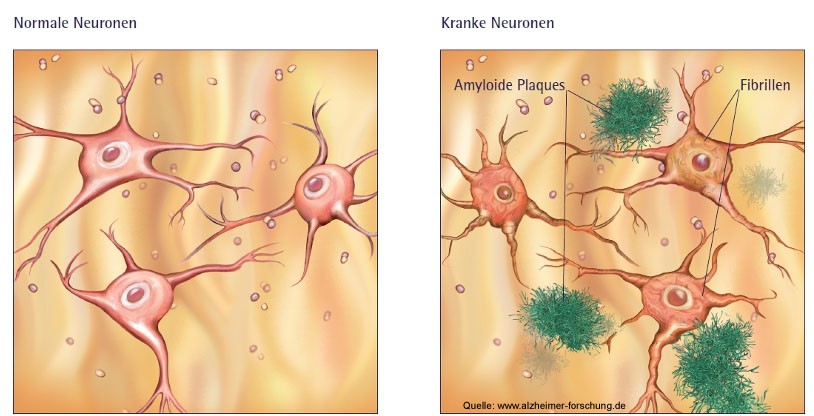
Thereby circulatory disorders and the formation of dangerous deposits form a cycle. The plaques prevent the natural expansion of blood vessels, thus it comes to circulatory disorders, which in turn have the effect that the plaques are not sufficiently removed. As a result its concentration continues to rise.
While Alzheimer’s disease progresses, there is a comprehensive reduction of brain tissue, the loss of neurons and synapses – the brain tissue deteriorates.

Especially the hippocampus is affected by the changes first, a central region for learning and memory, as well as the feelings and behavior influencing limbic system. In addition, areas of the brain are affected, in which speech and associations are processed. Over time, the disease processes infringe on the cortex. In addition, the ventricles, which contain cerebrospinal fluid, are greatly expanded. Damage to the frontal lobe causes changes in personality and behavior.